Borobudur preserves Buddhist teachings through ancient architecture, reliefs and conservation in Indonesia.
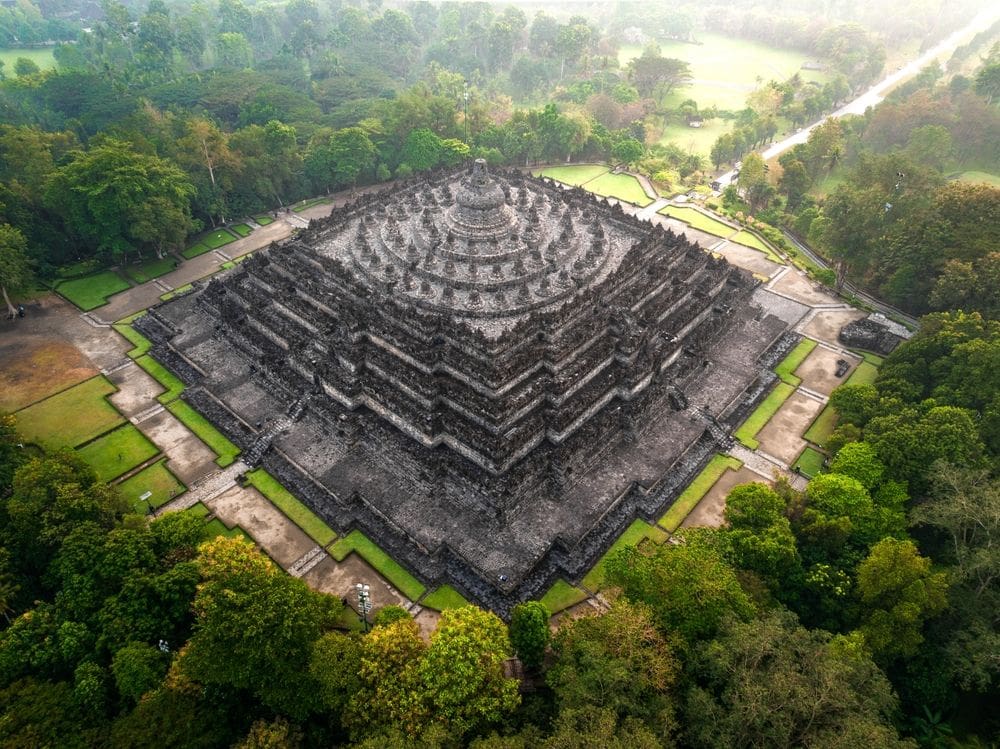
Borobudur Temple is an eighth- to ninth-century Buddhist monument in Magelang Regency, Central Java, Indonesia. Built during the Syailendra Dynasty, it was inscribed on UNESCO’s World Heritage List in 1991 as part of the Borobudur Temple Compounds, together with Candi Mendut and Candi Pawon. The complex reflects the religious beliefs, artistic traditions and architectural achievements of ancient Java.
The monument features a pyramidal base with five square terraces, three circular platforms and a central stupa. Its walls and balustrades contain 2,672 relief panels covering approximately 2,500 square metres. Indonesia’s Borobudur Conservation Centre records 1,460 narrative panels and 1,212 decorative panels, alongside 504 Buddha statues. The upper platforms feature 72 perforated stupas, each enclosing a Buddha statue.
The layout represents three Buddhist cosmological realms. Kamadhatu, associated with worldly desires, occupies the base; Rupadhatu, the realm of form, corresponds to the square terraces; and Arupadhatu, the formless realm, is represented by the circular platforms. The progression towards the summit symbolises a spiritual journey towards liberation.
The reliefs illustrate Buddhist teachings through stories from religious literature. Lalitavistara recounts the life of Siddhartha Gautama Buddha, while Jataka and Avadana narratives explore virtue and previous lives. Gandavyuha follows the spiritual journey of the Bodhisattva Sudhana in pursuit of wisdom. These carvings provide a visual record of Buddhist thought and artistic practice.
Borobudur served as a Buddhist site before being abandoned sometime between the tenth and fifteenth centuries, although the precise reasons remain uncertain. In 1814, Sir Thomas Stamford Raffles instructed H.C. Cornelius to clear the overgrown structure. Dutch engineer Theodoor van Erp led an extensive restoration between 1907 and 1911. A subsequent conservation programme conducted by the Indonesian Government with UNESCO’s assistance from 1973 to 1983 focused on structural stability and drainage.
Today, conservation efforts address natural weathering and visitor pressure. The surrounding communities also maintain traditional crafts, including batik, wood and bamboo carving, pottery and weaving inspired by the monument’s visual heritage. The complex remains a destination for cultural tourism and Buddhist pilgrimage, particularly during annual Vesak celebrations.
Located approximately 40 kilometres northwest of Yogyakarta city, Borobudur is accessible by road from central Yogyakarta and Yogyakarta International Airport in Kulon Progo. Travellers from Semarang can continue to Magelang by bus or private vehicle.
Visitors can book admission through the official InJourney Destination ticketing website. The Temple Ground ticket provides access to the courtyard, while the Temple Structure option permits visitors to climb the monument, subject to applicable conditions. Travellers should consult the official website for current prices, availability, visitor limits and booking requirements.
Source: Indonesian Ministry of Tourism